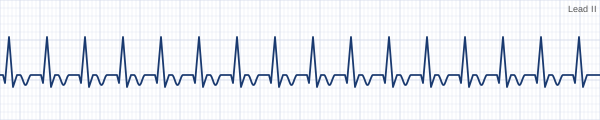
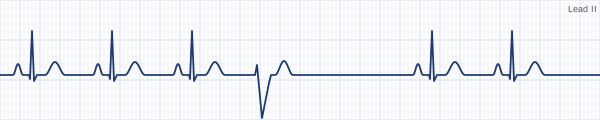
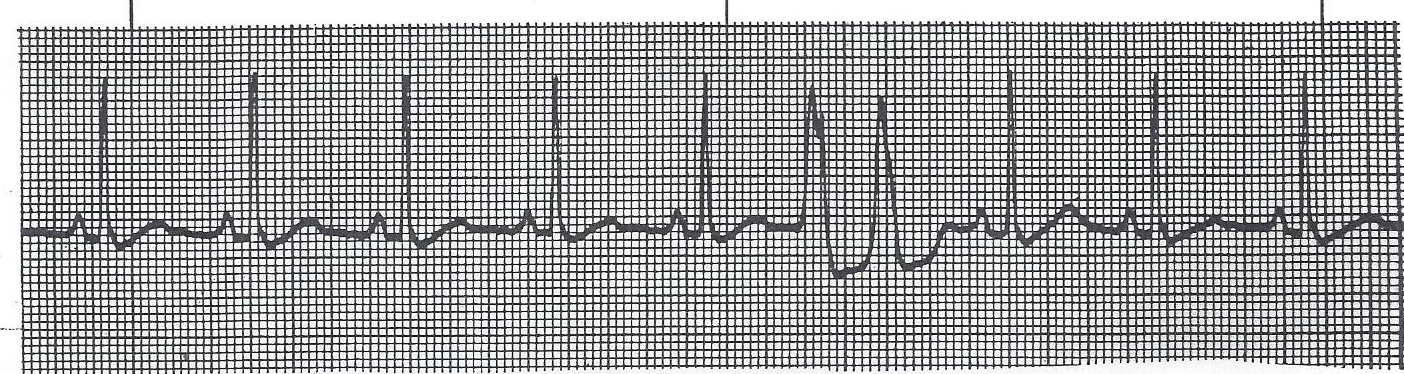
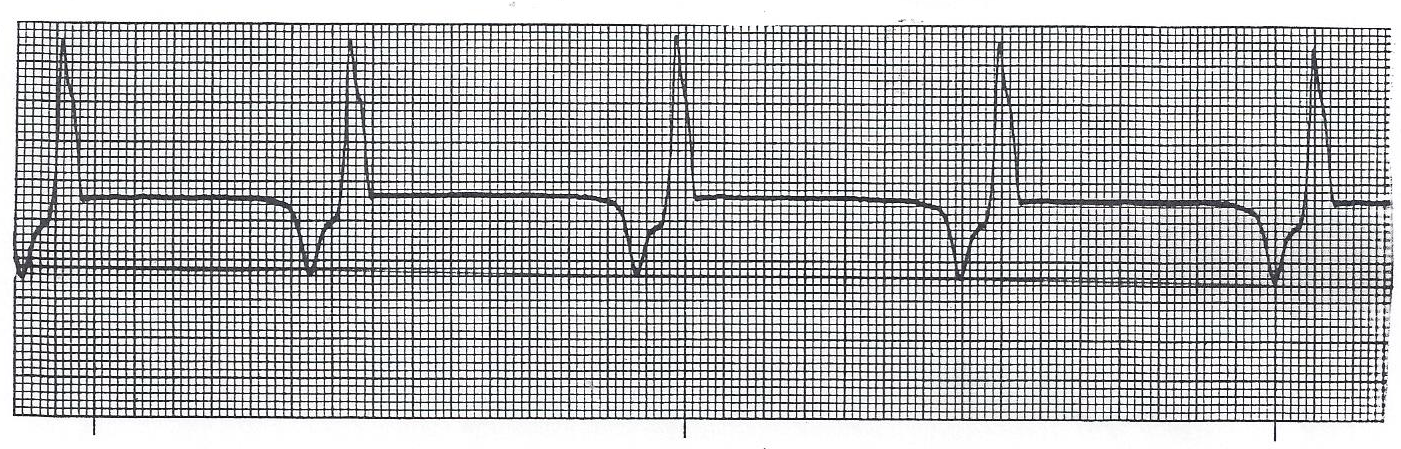
F.F. Thompson Hospital · Canandaigua, NY
For educational use during class presentation
Fill in blanks as your instructor covers each topic
Name:
Unit / Department:
Class Date:
Table of Contents
Dysrhythmia Recognition & Response · 2026
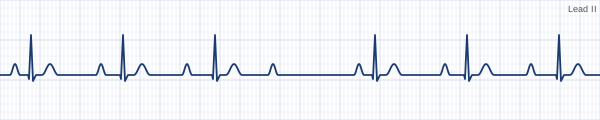
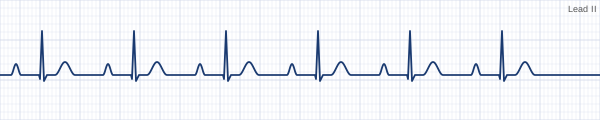
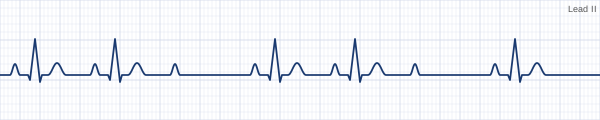
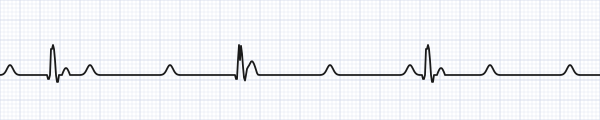
This workbook follows the live class presentation. Fill in blanks during lecture.
Use the notes spaces to capture what your instructor emphasizes.
Modules
1 · Introduction & Conduction System
3
2 · AV Blocks (Heart Blocks)
4–5
3 · Pacemakers
6
4 · ECG Basics & The 5-Step Method
7–9
5 · Sinus Rhythms
10
6 · Atrial Rhythms (PAC / Flutter / AFib / SVT)
11
7 · Junctional Rhythms
12
8 · Ventricular Rhythms & Arrest
13
Reference Tools
Rhythm Identification Flowchart
13
Practice
Practice Strips (20 strips — unlabeled)
15–24
Final Assessment — Capstone Strips
25
How to use this booklet: Your instructor will present each module using the course slides.
As they teach, fill in the blanks in each section. The blanks are clues — they mark the most important facts to remember.
Each module includes a practice strip — apply what you just learned before moving on.
Why AV Blocks & Pacemakers Come First:Understanding why conduction can fail — and how we compensate — makes every subsequent rhythm click into place.
Learn the blocks, then the 5-step method will feel like second nature.
The Clinical MantraRecognize → Assess → Act.
Every rhythm you learn leads to a clinical decision. Rate and rhythm on paper only matter in the context of how your patient looks.
2
Module 1 · Introduction & Conduction System
Foundation
The Clinical Approach
The three-step mantra: → →
Always treat the , not the monitor
Signs of instability: hypotension, chest pain, , altered level of consciousness
The Electrical Pathway
Fill in the conduction pathway in order:
SA Node
→→→→
Pacemaker Hierarchy
Pacemaker Site
Intrinsic Rate
Resulting Rhythm If Primary
SA Node
– bpm
Normal Sinus Rhythm
AV Junction
– bpm
rhythm
Ventricles
– bpm
Idioventricular rhythm
Key Point
Higher pacemakers suppress lower ones. If the SA node fails, the AV junction takes over — but at a slower rate.
Each backup pacemaker is a safety net, not a normal state.
Notes
3
Module 2 · AV Blocks (Heart Blocks)
Rhythm Recognition · AV Node
All AV blocks share one feature: between atria and ventricles.
Block Type
PR Interval
Dropped Beats?
QRS
Risk Level
1st Degree
> sec, constant
None
Narrow
2nd Degree Type I (Wenckebach)
Progressively
Yes — ically
Usually narrow
2nd Degree Type II (Mobitz II)
(fixed)
Yes — ly
Often wide
— can progress to 3rd degree
3rd Degree (Complete)
(no relationship)
Complete dissociation
Wide (ventricular) or narrow (junctional)
— emergent pacing
♥ Heart Block Decision Tree
START: Look at the PR intervals — are they consistent?
↓
BRANCH A — PR is FIXED (same before every beat)
Are ALL beats conducted? (No dropped QRS?)
YES ↓
PR > 0.20 sec?
YES ↓
✔ First-Degree AV Block PR prolonged but constant; all beats conduct
NO ↓
Normal conduction Not a block — PR is normal & all beats present
NO — beats are dropped ↓
QRS drops suddenly with no warning? (PR fixed right up to the drop)
YES ↓
⚠ Second-Degree Type II — Mobitz II Fixed PR → sudden QRS disappears. HIGH RISK — can deteriorate to 3rd degree. Prepare to pace.
BRANCH B — PR is VARIABLE (changes beat to beat)
Does the PR progressively lengthen, then a beat drops — then cycle repeats?
YES ↓
↗ Second-Degree Type I — Wenckebach PR gradually ↑ → dropped QRS → reset → repeat. Usually benign, but monitor.
Are P waves and QRS complexes completely independent? (Different rates, no relationship, no pattern)
↓
🚨 Third-Degree (Complete) Heart Block AV dissociation. Atria and ventricles march independently. EMERGENT PACING REQUIRED.
⚠ Remember: 3rd degree HAS visible P waves — they just march independently and bear no relationship to the QRS. Do not mistake P waves for "normal conduction."
4
Module 2 (cont.) · AV Blocks — Clinical Details & Practice
Rhythm Recognition · AV Node
Wenckebach (Type I) Clues
PR gets then drops a beat
Cycle then
The RR intervals get progressively
Location: usually at node
Generally (benign / dangerous)
▶ Strip: Identify — Wenckebach or other?
Rate
Rhythm
Interpretation
Action
▶ Strip: Is the PR interval prolonged?
Rate
Rhythm
Interpretation
Action
Mobitz II Clues
PR interval is until a beat drops
No warning — the QRS just
Location: below the
Can deteriorate to
Action: prepare for
▶ Strip: Fixed PR or lengthening?
Rate
Rhythm
Interpretation
Action
▶ Strip: Are P waves and QRS related?
Rate
Rhythm
Interpretation
Action
Key Point — 3rd Degree Block
Complete AV dissociation: P waves and QRS complexes march on independently.
The atrial rate is faster than the ventricular rate.
This is a medical emergency — the ventricles are running on their own escape rhythm.
Notes
5
Module 3 · Pacemakers
Paced Rhythms & Malfunctions
Recognizing Paced Rhythms
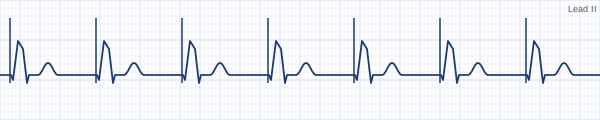
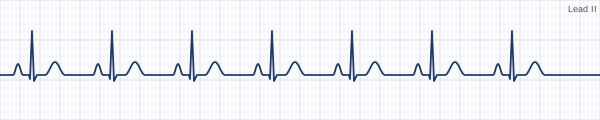
A pacemaker appears as a sharp vertical mark
Atrial pacing: spike before wave
Ventricular pacing: spike before (wide QRS)
Dual-chamber: spikes per beat
A paced QRS is (narrow / wide)
Types of Pacemakers
Transcutaneous: (temporary, external)
Transvenous: temporary,
Permanent: implanted,
VVI mode: paces , senses , inhibits on demand
▶ Strip: Find the pacer spikes
Rate
Rhythm
Interpretation
Action
Pacemaker Malfunctions
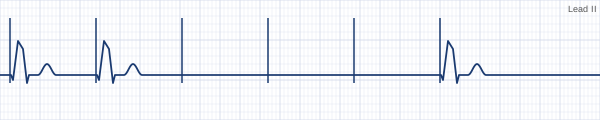
Failure to Capture:
Spike present but no follows
Causes: lead displacement, , threshold change
Action: increase output /
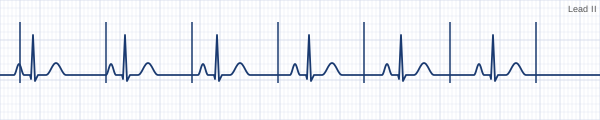
Failure to Sense:
Pacemaker fires a native beat (can't "see" it)
Appears as: spikes in places
Risk:
Failure to Pace:
No spike when one is expected
Causes: battery depletion,
Action:
▶ Strip: Capture present?
Rate
Rhythm
Interpretation
Action
▶ Strip: Any sensing issues?
Rate
Rhythm
Interpretation
Action
Key Point
Capture = spike followed by a P wave or QRS complex.
If you see a pacemaker spike without a following deflection → failure to capture.
Always assess the patient — is the underlying rate adequate without pacemaker support?
Notes
6
Independent Practice — Break 1
Heart Blocks & Pacing · Complete independently · Review with class after break
Interpret each strip using your clinical observation skills. Tip: We'll introduce a systematic 5-step approach in Module 4 — you'll use it for all future strips.
Strip 1
Rate
Rhythm
P Waves
PR Interval
QRS Width
Interpretation
Clinical Action
Strip 2
Rate
Rhythm
P Waves
PR Interval
QRS Width
Interpretation
Clinical Action
Strip 3
Rate
Rhythm
P Waves
PR Interval
QRS Width
Interpretation
Clinical Action
B1-1
Independent Practice — Break 1 (cont.)
Heart Blocks & Pacing · Strips 4–6
Strip 4
Rate
Rhythm
P Waves
PR Interval
QRS Width
Interpretation
Clinical Action
Strip 5
Rate
Rhythm
P Waves
PR Interval
QRS Width
Interpretation
Clinical Action
Strip 6
Rate
Rhythm
P Waves
PR Interval
QRS Width
Interpretation
Clinical Action
B1-2
Independent Practice — Break 1 · Clinical Scenario
Apply: Recognize → Assess → Act
Clinical Scenario
72-year-old male admitted for syncope. History: dual-chamber pacemaker implanted 2 years ago for complete heart block. Current vitals: HR 32, BP 88/52, SpO₂ 94% RA, confused and diaphoretic.
What rhythm is shown? _______________________________________________
What is the rate? ___________________________________________________
Is this patient stable or unstable based on HR 32, BP 88/52, and confusion? _________________________________________
What is your FIRST nursing action? _________________________________________
B1-3
Module 4 · ECG Basics & Paper Reading
Foundation
ECG Paper — Horizontal (Time)
1 small box = seconds
1 large box = seconds
5 large boxes = second(s)
Standard paper speed = mm/sec
ECG Paper — Vertical (Amplitude)
1 small box = mV
1 large box = mV
Standard: 10 mm = mV
Normal Intervals
Interval
Normal Range
P wave
< sec
PR interval
– sec
QRS complex
< sec
QT interval
< sec (HR dependent)
PR in small boxes: to boxes
QRS in small boxes: < boxes
Waveform Meanings
Waveform / Interval
Electrical Event
What it means clinically
P wave
Atria contract
QRS complex
Ventricles contract
T wave
Ventricles reset
PR interval
Atrial depolarization +
AV node conduction time
Key Point
Normal PR = 0.12–0.20 sec (3–5 small boxes). Normal QRS < 0.12 sec (< 3 small boxes).
Wide QRS means the signal traveled an abnormal path through the ventricles.
Now that you've seen what blocks look like — a prolonged PR takes on new meaning!
Notes
7
Module 4 (cont.) · The 5-Step Rhythm Method
Core Skill
Apply these steps in order for every rhythm strip. Write the step name in each blank.
1Step 1:
Is the rhythm regular or irregular?
Method:
2Step 2:
Count QRS complexes in -second strip ×
Or: 300 ÷
3Step 3:
Are they present?
Upright?
One per QRS?
4Step 4:
Normal range: – sec
Consistent or changing?
5Step 5:
Normal QRS is (narrow / wide)
Wide QRS suggests:
Rate Calculation — 6-Second Method
Count the number of complexes in a 6-second strip
Multiply by to get beats per minute
6 seconds = large boxes on standard ECG paper
This method works best for rhythms
Key Point
Use the same 5 steps on every strip, every time. Consistency prevents errors.
After every interpretation: "Is this patient stable?"
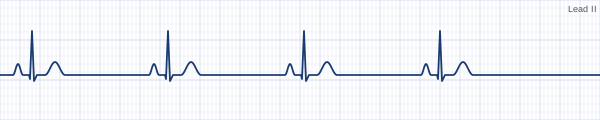
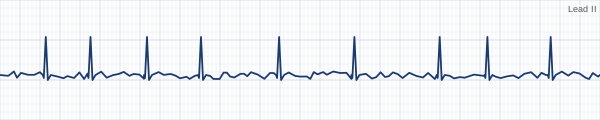
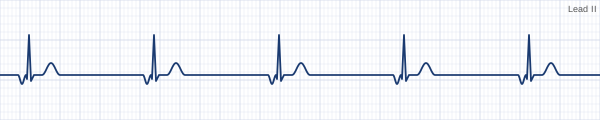
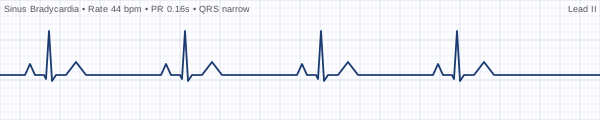
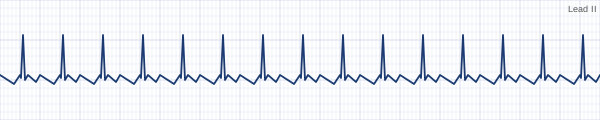
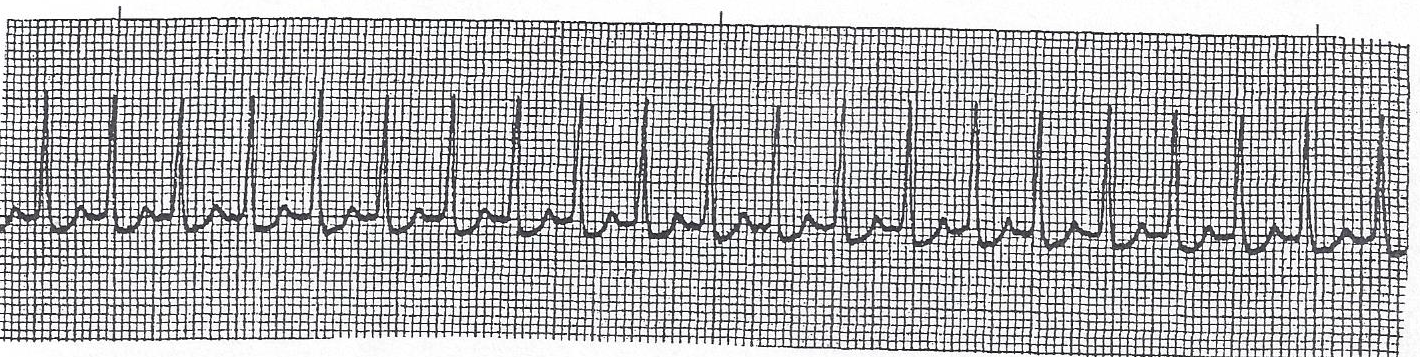
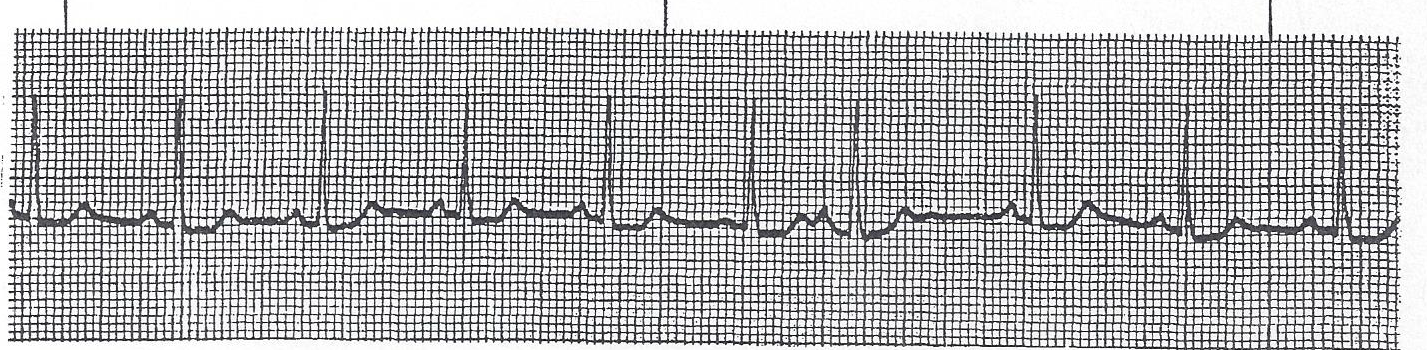
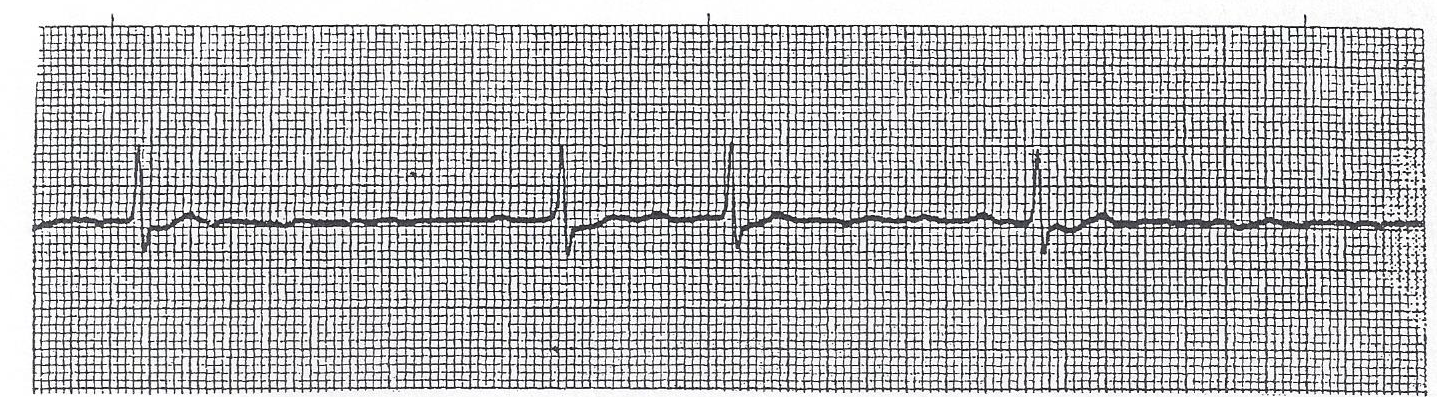
Use this strip. Walk through all 5 steps out loud before writing your interpretation.
▶ Apply the 5-Step Method — identify this rhythm
Step 1 — Rhythm (regular or irregular?)
Step 2 — Rate (6-sec method)
Step 3 — P Waves (present? upright? 1 per QRS?)
Step 4 — PR Interval (normal / long / variable?)
Step 5 — QRS Width (narrow or wide?)
Interpretation:
Notes
9
Module 5 · Sinus Rhythms
Rhythm Recognition
Rhythm
Rate
P Waves
PR / QRS
Common Cause / Action
Normal Sinus Rhythm
– bpm
Upright, per QRS
Normal
No action needed
Sinus Bradycardia
< bpm
Normal
Normal
Treat if
Sinus Tachycardia
> bpm
Normal
Normal
Treat the
Sinus Arrhythmia
60–100 bpm
Normal
Normal
Rate varies with
Key Teaching Points
All sinus rhythms originate in the node
Sinus bradycardia causes: , medications, athletes
Sinus tachycardia causes: — always find the cause
Sinus tachycardia with hemodynamic instability: consider
A wandering pacemaker has ≥ different P-wave morphologies
Key Point — Sinus Brady
A rate below 60 bpm is only an emergency if the patient is symptomatic.
Athletes and sleeping patients may have heart rates in the 40s — this is normal for them.
Key Point — Sinus Tachy
Sinus tachycardia is always a response to something (pain, fever, fear, hypovolemia).
Treat the cause, not the number on the monitor.
▶ Practice: Sinus rhythm — fast, slow, or normal?
Step 1 — Rate
Step 2 — Rhythm
Step 3 — P Waves / PR
Step 5 — QRS / Interpretation
Clinical Scenario — Practice
Patient: HR 48 · BP 108/68 · SpO₂ 97% · Alert & oriented · No complaints
This rhythm strip shows sinus bradycardia. What is the most appropriate action?
Is this patient hemodynamically stable?
Does the rate alone require treatment?
What is your action?
Notes
10
Module 6 · Atrial Rhythms
Rhythm Recognition
PAC (Premature Atrial Contraction)
Origin: ectopic focus in
P wave: present but
Appears than expected
QRS: usually (narrow / wide)
Clinical: usually
Atrial Flutter
Atrial rate: approximately bpm
Classic pattern: waves (sawtooth)
Conduction ratio: often :1 or :1
Ventricular rate with 4:1 block ≈ bpm
Risk: can convert to
Atrial Fibrillation
Atrial rate: – bpm (chaotic)
Ventricular rhythm: irregularly
P waves: absent, replaced by
Major risk: (stroke)
Anticoagulation decision: use score
SVT (Supraventricular Tachycardia)
Rate: – bpm
Onset: sudden / gradual (circle one)
P waves: or retrograde
First intervention:
Drug of choice:
Key Point — AFib
The hallmark of AFib is an irregularly irregular ventricular rhythm with no identifiable P waves.
The big danger isn't the rate — it's the thrombus that forms in the non-contracting atrium.
▶ Practice: Identify the atrial rhythm — P waves present?
Step 1 — Rate
Step 2 — Rhythm
Step 3 — P Waves / PR
Step 5 — QRS / Interpretation
Notes
11
Module 7 · Junctional Rhythms
Rhythm Recognition
When the AV Junction Takes Over
Junctional rhythms occur when the fails or is suppressed
Junctional escape rate: – bpm
Accelerated junctional rate: – bpm
Junctional tachycardia rate: > bpm
P Wave Clues in Junctional Rhythm
P waves may be: (1) (before QRS, inverted) or
(2) (buried in QRS, not visible) or
(3) (after QRS)
When P wave precedes QRS, PR interval is than normal (< 0.12 sec)
QRS width: usually (narrow / wide)
Clinical Significance
Type
Rate
Priority
Common Cause
Junctional Escape
40–60 bpm
SA node failure, vagal tone
Accelerated Junctional
60–100 bpm
Monitor
Junctional Tachycardia
> 100 bpm
Dig toxicity, ischemia
Key Point
Junctional rhythms are escape rhythms — the junction fires because a higher pacemaker failed.
The key question: why did the SA node fail? Look for medications, ischemia, or high vagal tone.
Inverted P wave rule: If P waves are inverted in leads II, III, and aVF → the impulse is going up the atria instead of down → junctional or ventricular origin.
▶ Practice: Where are the P waves?
Step 1 — Rate
Step 2 — Rhythm
Step 3 — P Waves / PR
Step 5 — QRS / Interpretation
Notes
12
Independent Practice — Break 2
Atrial & Junctional Rhythms · Complete independently · Review with class after break
Apply the 5-Step Rhythm Method to every strip: Rate → Rhythm → P Waves → PR Interval → QRS Width → Interpretation. Complete independently before the group review.
Strip 1
Step 1 — Rate
Step 2 — Rhythm
Step 3 — P Waves
Step 4 — PR Interval
Step 5 — QRS Width
Interpretation
Clinical Action
Strip 2
Step 1 — Rate
Step 2 — Rhythm
Step 3 — P Waves
Step 4 — PR Interval
Step 5 — QRS Width
Interpretation
Clinical Action
Strip 3
Step 1 — Rate
Step 2 — Rhythm
Step 3 — P Waves
Step 4 — PR Interval
Step 5 — QRS Width
Interpretation
Clinical Action
B2-1
Independent Practice — Break 2 (cont.)
Atrial & Junctional Rhythms · Strips 4–6
Strip 4
Step 1 — Rate
Step 2 — Rhythm
Step 3 — P Waves
Step 4 — PR Interval
Step 5 — QRS Width
Interpretation
Clinical Action
Strip 5
Step 1 — Rate
Step 2 — Rhythm
Step 3 — P Waves
Step 4 — PR Interval
Step 5 — QRS Width
Interpretation
Clinical Action
Strip 6
Step 1 — Rate
Step 2 — Rhythm
Step 3 — P Waves
Step 4 — PR Interval
Step 5 — QRS Width
Interpretation
Clinical Action
B2-2
Independent Practice — Break 2 · Clinical Scenario
Apply: Recognize → Assess → Act
Clinical Scenario
68-year-old female with known chronic AFib on anticoagulation therapy. Current vitals: HR 148, BP 106/72, SpO₂ 96% RA, alert and oriented. Complains of palpitations and mild fatigue.
What rhythm is shown? _______________________________________________
What is the rate? ___________________________________________________
Is this patient stable or unstable based on HR 148, BP 106/72, and mental status? _________________________________________
What is your FIRST nursing action? _________________________________________
B2-3
Module 8 · Ventricular Rhythms & Arrest
Rhythm Recognition · Emergency
Rhythm
QRS Width
Rate
Key Feature
Immediate Action
PVC
> sec
Varies
, no P wave before
Monitor; treat if >/min or runs
V-Tach (sustained)
Wide
> bpm
≥ consecutive PVCs
If stable: ; if unstable:
Ventricular Fib
No QRS
No pulse
Chaotic,
Immediate + CPR
Idioventricular
Wide
– bpm
Escape rhythm
Do NOT suppress; find cause
Asystole
None
0
(flat line)
CPR, epinephrine, find cause
PVC Patterns — Know These
Unifocal PVCs: all (same shape)
Multifocal PVCs: different — more concerning
Bigeminy: every beat is a PVC
Trigeminy: every beat is a PVC
Couplet: PVCs in a row
Triplet: PVCs in a row
R-on-T phenomenon: PVC falls on the wave → can trigger
▶ Practice: Wide QRS — count the rate, check for P waves
Step 1 — Rate
Step 2 — Rhythm
Step 3 — P Waves / PR
Step 5 — QRS / Interpretation
⚡ Defibrillation is the only definitive treatment for VFib and pulseless V-Tach.
Begin CPR immediately while the defibrillator charges. Every second counts.
Notes
13
Independent Practice — Break 3
Ventricular Rhythms · Complete independently · Review with class after break
Apply the 5-Step Rhythm Method to every strip: Rate → Rhythm → P Waves → PR Interval → QRS Width → Interpretation. Complete independently before the group review.
Strip 1
Step 1 — Rate
Step 2 — Rhythm
Step 3 — P Waves
Step 4 — PR Interval
Step 5 — QRS Width
Interpretation
Clinical Action
Strip 2
Step 1 — Rate
Step 2 — Rhythm
Step 3 — P Waves
Step 4 — PR Interval
Step 5 — QRS Width
Interpretation
Clinical Action
Strip 3
Step 1 — Rate
Step 2 — Rhythm
Step 3 — P Waves
Step 4 — PR Interval
Step 5 — QRS Width
Interpretation
Clinical Action
B3-1
Independent Practice — Break 3 (cont.)
Ventricular Rhythms · Strips 4–6
Strip 4
Step 1 — Rate
Step 2 — Rhythm
Step 3 — P Waves
Step 4 — PR Interval
Step 5 — QRS Width
Interpretation
Clinical Action
Strip 5
Step 1 — Rate
Step 2 — Rhythm
Step 3 — P Waves
Step 4 — PR Interval
Step 5 — QRS Width
Interpretation
Clinical Action
Strip 6
Step 1 — Rate
Step 2 — Rhythm
Step 3 — P Waves
Step 4 — PR Interval
Step 5 — QRS Width
Interpretation
Clinical Action
B3-2
Independent Practice — Break 3 · Clinical Scenario
Apply: Recognize → Assess → Act
Clinical Scenario
Post-operative day 1 patient found unresponsive in bed. Monitor shows wide complex tachycardia at rate 180 bpm. No palpable pulse. Code team has been activated.
What rhythm is shown? _______________________________________________
What is the rate? ___________________________________________________
What did the nurse find when checking for a pulse? _________________________________________
What is the appropriate treatment pathway for this rhythm without a pulse? _________________________________________
B3-3
Rhythm Identification Flowchart
Bedside Reference Tool
You see a rhythm on the monitor
↓
STEP 1: Screen for Heart Block FIRST (Check PR interval)
Is the PR interval present and CONSISTENT?
PR progressively LENGTHENS → dropped QRS?
Cycle repeats (group patterns)
↳ Wenckebach (Type I)
PR FIXED → sudden dropped QRS?
No progressive change
↳ Mobitz II (Type II) ⚠
P waves & QRS completely UNRELATED (diff. rates)?
AV dissociation
↳ 3rd-Degree Block 🚨
PR > 0.20 sec but ALL beats conduct?
No dropped beats
↳ 1st-Degree Block ✔
↓ If no block pattern identified — continue to 5-Step Method below ↓
Always: After identifying the rhythm — assess the patient. Rate and rhythm only matter in context. Ask: "Is my patient hemodynamically stable?"
14
Practice Strips
Apply the 5-Step Method · Interpret Each Strip
Apply the 5-Step Rhythm Method to every strip: Rate → Rhythm → P Waves → PR Interval → QRS Width → Interpretation. Complete all fields independently before asking your instructor.
Strip 1
Step 1 — Rate
Step 2 — Rhythm
Step 3 — P Waves
Step 4 — PR Interval
Step 5 — QRS Width
Interpretation
Clinical Action
Strip 2
Step 1 — Rate
Step 2 — Rhythm
Step 3 — P Waves
Step 4 — PR Interval
Step 5 — QRS Width
Interpretation
Clinical Action
15
Practice Strips (cont.)
Apply the 5-Step Method · Interpret Each Strip
Strip 3
Step 1 — Rate
Step 2 — Rhythm
Step 3 — P Waves
Step 4 — PR Interval
Step 5 — QRS Width
Interpretation
Clinical Action
Strip 4
Step 1 — Rate
Step 2 — Rhythm
Step 3 — P Waves
Step 4 — PR Interval
Step 5 — QRS Width
Interpretation
Clinical Action
16
Practice Strips (cont.)
Apply the 5-Step Method · Interpret Each Strip
Strip 5
Step 1 — Rate
Step 2 — Rhythm
Step 3 — P Waves
Step 4 — PR Interval
Step 5 — QRS Width
Interpretation
Clinical Action
Strip 6
Step 1 — Rate
Step 2 — Rhythm
Step 3 — P Waves
Step 4 — PR Interval
Step 5 — QRS Width
Interpretation
Clinical Action
17
Practice Strips (cont.)
Apply the 5-Step Method · Interpret Each Strip
Strip 7
Step 1 — Rate
Step 2 — Rhythm
Step 3 — P Waves
Step 4 — PR Interval
Step 5 — QRS Width
Interpretation
Clinical Action
Strip 8
Step 1 — Rate
Step 2 — Rhythm
Step 3 — P Waves
Step 4 — PR Interval
Step 5 — QRS Width
Interpretation
Clinical Action
18
Practice Strips (cont.)
Apply the 5-Step Method · Interpret Each Strip
Strip 9
Step 1 — Rate
Step 2 — Rhythm
Step 3 — P Waves
Step 4 — PR Interval
Step 5 — QRS Width
Interpretation
Clinical Action
Strip 10
Step 1 — Rate
Step 2 — Rhythm
Step 3 — P Waves
Step 4 — PR Interval
Step 5 — QRS Width
Interpretation
Clinical Action
19
Practice Strips (cont.)
Apply the 5-Step Method · Interpret Each Strip
Strip 11
Step 1 — Rate
Step 2 — Rhythm
Step 3 — P Waves
Step 4 — PR Interval
Step 5 — QRS Width
Interpretation
Clinical Action
Strip 12
Step 1 — Rate
Step 2 — Rhythm
Step 3 — P Waves
Step 4 — PR Interval
Step 5 — QRS Width
Interpretation
Clinical Action
20
Practice Strips (cont.)
Apply the 5-Step Method · Interpret Each Strip
Strip 13
Step 1 — Rate
Step 2 — Rhythm
Step 3 — P Waves
Step 4 — PR Interval
Step 5 — QRS Width
Interpretation
Clinical Action
Strip 14
Step 1 — Rate
Step 2 — Rhythm
Step 3 — P Waves
Step 4 — PR Interval
Step 5 — QRS Width
Interpretation
Clinical Action
21
Practice Strips (cont.)
Apply the 5-Step Method · Interpret Each Strip
Strip 15
Step 1 — Rate
Step 2 — Rhythm
Step 3 — P Waves
Step 4 — PR Interval
Step 5 — QRS Width
Interpretation
Clinical Action
Strip 16
Step 1 — Rate
Step 2 — Rhythm
Step 3 — P Waves
Step 4 — PR Interval
Step 5 — QRS Width
Interpretation
Clinical Action
22
Practice Strips (cont.)
Apply the 5-Step Method · Interpret Each Strip
Strip 17
Step 1 — Rate
Step 2 — Rhythm
Step 3 — P Waves
Step 4 — PR Interval
Step 5 — QRS Width
Interpretation
Clinical Action
Strip 18
Step 1 — Rate
Step 2 — Rhythm
Step 3 — P Waves
Step 4 — PR Interval
Step 5 — QRS Width
Interpretation
Clinical Action
23
Practice Strips (cont.)
Apply the 5-Step Method · Interpret Each Strip
Strip 19
Step 1 — Rate
Step 2 — Rhythm
Step 3 — P Waves
Step 4 — PR Interval
Step 5 — QRS Width
Interpretation
Clinical Action
Strip 20
Step 1 — Rate
Step 2 — Rhythm
Step 3 — P Waves
Step 4 — PR Interval
Step 5 — QRS Width
Interpretation
Clinical Action
Well done! You've worked through 20 strips using the 5-step method.
Rhythm interpretation is a skill built with repetition. Keep practicing, and always connect the rhythm to your patient's clinical picture.
Remember: Recognize → Assess → Act.